


Table of Contents
All campaigns these days use voter data. From planning out communication strategies to structuring messages for specific voters, every step is guided through voter data campaigns. Campaigns hire analysts and consultants from data firms specifically for their data operations.
Voter data allows political campaigns to identify and target specific demographics or voter segments more effectively. By understanding the preferences, concerns, and behaviors of different groups of voters, campaigns can tailor their messaging and outreach strategies to resonate with those audiences.
Overall, voter data empowers political campaigns with the information and tools needed to run efficient, targeted, and impactful election campaigns, ultimately influencing electoral outcomes.
How do you do that? Here are the steps you need to know.
Acquire your voter list
States possess diverse criteria concerning who can demand a voter list, the content within it, what voter data remains private, and the permissible use of such information.

Every state permits certain levels of access to voter registration data for political parties and candidates running for elected positions. Depending on your state of residence, your voter details might also be disclosed to law enforcement, governmental authorities, businesses, researchers, journalists, and the wider public.
By the numbers:
- 31 states have no restrictions on who can purchase voter lists (open).
- 16 states restrict some voter data to only certain individuals and groups, while anyone can purchase the rest of the voter data (mixed).
- 4 states restrict all voter data to only certain types of individuals or groups (restricted).
How to access and use voter data from state governments
There is a long-standing tradition of accessing voter lists for political campaigns. Candidates definitely get a huge boost by identifying their party’s supporters, but not every record is accessible to the public. But you can still use voter data that is available.
The costs for these can range from $0 in Oklahoma to $37,000 in Alabama.
| Please note: If you are affiliated with the two major parties: 1. Democrats or 2. Republicans The party’s national committees will provide you with the data for your campaign. |
Purchasing voter lists and to use voter data
The advantage of buying voter lists from ‘big data’ companies is that they will provide the voter data matching as per your needs and match it with other data (like home ownership, voting pattern, education, etc.) to make the data more useful for voter profiles.
Naturally, they charge a premium for these services, depending on the level of segmentation you require on your voter data. Here are some of the biggest players in the voter lists market:
- BIGDBM: One of the ‘big data’ firms ever since they began in 2016, they claim to have a database of 250 million registered voters. They provide ‘identity graphs’ that help you map your campaign to your target audience by including consumer data, making voter data analysis much easier.
- Aristotle: Started in 1983, this well-known firm provides voter data, machine learning, and data analytics. Interestingly, the team is led by a former two-term Federal Election Commission Chairman. They claim to have over 235 million voters on their lists.
- L2: A popular source for 50 years, L2 claims it does voter data matching with 53 data points, providing a deep look into every voter profile. They claim to have data on 215 million voters.
- TargetSmart: Since launching more than 15 years ago, TargetSmart has established itself as the leading provider of political voter data for progressive campaigns and advocacy organizations.

Image Source: Statista
How many registered voters are in the US?
There are 161 million registered voters in the United States, as measured by the census in 2022.
Here’s a table with the data broken down by state:
| Census: November 2022 | Number of Registered Voters (in millions) |
| United States | 161 (Total) |
| Alabama | 2 |
| Alaska | 0.373 |
| Arizona | 3 |
| Arkansas | 1.36 |
| California | 17.03 |
| Colorado | 3.16 |
| Connecticut | 1.77 |
| Delaware | 0.5 |
| District of Columbia | 0.39 |
| Florida | 9.7 |
| Georgia | 5.2 |
| Hawaii | 0.65 |
| Idaho | 0.91 |
| Illinois | 6.1 |
| Indiana | 3.2 |
| Iowa | 1.7 |
| Kansas | 1.5 |
| Kentucky | 2.3 |
| Louisiana | 2.2 |
| Maine | 0.85 |
| Maryland | 3.3 |
| Massachusetts | 3.6 |
| Michigan | 5.7 |
| Minnesota | 3.2 |
| Mississippi | 1.5 |
| Missouri | 3.5 |
| Montana | 0.61 |
| Nebraska | 0.93 |
| Nevada | 1.4 |
| New Hampshire | 0.8 |
| New Jersey | 4.4 |
| New Mexico | 1.02 |
| New York | 8.8 |
| North Carolina | 4.5 |
| North Dakota | 0.41 |
| Ohio | 5.8 |
| Oklahoma | 1.9 |
| Oregon | 2.5 |
| Pennsylvania | 7 |
| Rhode Island | 0.62 |
| South Carolina | 2.4 |
| South Dakota | 0.46 |
| Tennessee | 3.4 |
| Texas | 12.4 |
| Utah | 1.5 |
| Vermont | 0.39 |
| Virginia | 4.4 |
| Washington | 4.1 |
| West Virginia | 0.87 |
| Wisconsin | 3.2 |
| Wyoming | 0.27 |
How to create your voter persona and use voter data?
While voter data is valuable for showing how many voters there are, it doesn’t help you win elections unless it’s used to build accurate ‘voter personas’. This is key, in politics, defining your ‘target voter’ is one of the main pillars towards victory.
You need to fully understand who your message resonates with, what kind of people they are, and where you can find them. And you need to replicate this exercise for all your policy points or beliefs.
Some of the data you will need to make a workable persona includes –
- Age
- Gender
- Race
- Relationship status
- Occupation
- Salary
- District
- Voting history
| Here’s a list of questions that can be explored to create a ‘voter persona’: 1. What does a typical day look like? 2. What social media are they on? 3. What publications (print or digital) do they read? 3. What do they do at work? 4. Do they have any hobbies? |
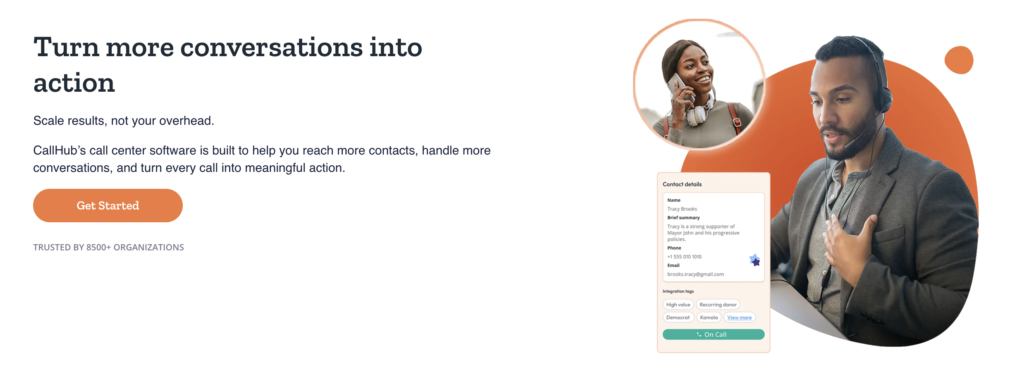
The best way to build this voter database is to make the calls and speak directly to the voters you want to address. Building a call center and running a campaign will give you the most up-to-date results. CallHub makes it easy to set up and run scalable call center campaigns—so every conversation updates your voter data in real time.
If you have time constraints, then you can also use the sources mentioned earlier to buy lists with voter personas, which they generate through their algorithms.
A sample voter persona will take you from ‘Dennis is registered to vote in Ohio’ to –
Dennis spends their day entirely at work and is looking for shorter hours at their workplace. They are very active on social media and read often about US foreign policy – a major concern for them. A long-time illness keeps health insurance on their mind, while their hiking hobby means forests and preservation is something that deeply resonates with them.
Attach a photo and a phone number – and when you call a voter within the region, age range, and political beliefs of this average ‘Dennis’, you can have a deep and meaningful conversation with them, possibly convincing them to vote for you.
While the ‘Dennis’ mentioned here is an example, typically campaigns create several voter personas – to help calling agents connect on a more personal level to every kind of voter the campaign is expected to appeal to.
Identify areas to focus on to use voter data
Here is a step-by-step plan on how you can use your voter data to get in more supporters to vote you.
Step 1: Identify supporter clusters: Once you know which voters are likely to support you, geocode their addresses to identify areas where your support is strongest. This helps reveal clusters of similar voters and highlights regions with the highest potential impact.
Step 2: Prioritize high-opportunity areas: Focus your campaign efforts on areas where you have better chances of winning over supporters. Use this insight to:
- Host local events, maybe a gala night or some
- Meet voters in person and know about their concerns
- Run volunteer activities
Lay out your campaign trail strategically so you reach all clusters of potential supporters.
Step 3: Validate & introduce through calling: Start with a calling campaign to confirm what your voter data already indicates, speak directly with voters, and introduce them to your candidacy through real, one-on-one conversations. This ensures your database stays accurate and up to date.
Step 4: Engage & activate with texting: After completing your calling campaigns, give a week of time and start texting campaigns to:
- Keep voters informed about your upcoming events
- Collect RSVPs for these events.
- Raise funds for your campaign
Texting helps maintain ongoing engagement after the initial call.
| Use CallHub’s texting campaigns—both mass texting for broad announcements and peer-to-peer texting for personal, one-on-one conversations—to reach voters effectively and keep your campaign momentum strong. |
Step 5: Maximize turnout with GOTV: Finally, run a Get Out the Vote (GOTV) campaign in these targeted areas to remind supporters to vote and maximize turnout on election day.
Calculate your win number
Every campaign starts with a win number – the number of votes you need to get elected. And here’s a good way to get to that number:
Step 1: How many people are going to vote?
The best way to get a workable ‘turnout’ prediction is to use three similar elections to help predict the one you are campaigning for. Remember you have to calculate the average ballots received and counted, and not just the number of registered voters.
Broadly, you can get an estimate of the voter turnout by taking the average percentage of voters who voted over the past three elections and taking that average percentage out of the registered voters in this election.
So if, on average, 70% voted in the past three elections, and 100,000 people are registered to vote in this one – your expected turnout will be 70% of 100,000 – 70,000 voters.
Here’s the math:
- Percentage of voter turnout of election one (X)
- % of voter turnout of election two (Y)
- Percentage of voter turnout of election three (Z)
| X + Y + Z / 3 = Average voter percentage over three elections (A) |
Average voter percentage (A) multiplied by the total number of registered voters for this election (B), divided by 100.
| A x B / 100 = Expected voter turnout (C) |
Step 2: Calculating the vote goal
Ideally, you need 51% to win. But you cannot aim to convert precisely 51% of the voting population; hence, an extra safety margin of around 20% is considered.
Considering the example mentioned earlier, of the 70,000 who will vote, you need 35,700 votes to win. But to be safe, you add 20% to that margin and aim for 50,000 votes in the election to ensure your victory.
Your ‘win number’ is 50,000. So you know you can use the voter data you have collected to form policies that appeal to at least 50,000 of the electorate. And hopefully, sweep the elections come voting day.
Here’s the math:
From the above example, you need:
| 51 x C / 100 = Minimum votes needed to win (D) |
| 20/100 x D = Safe margin of votes you need to win |
Read More: Detailed report on how to calculate your win number for an election
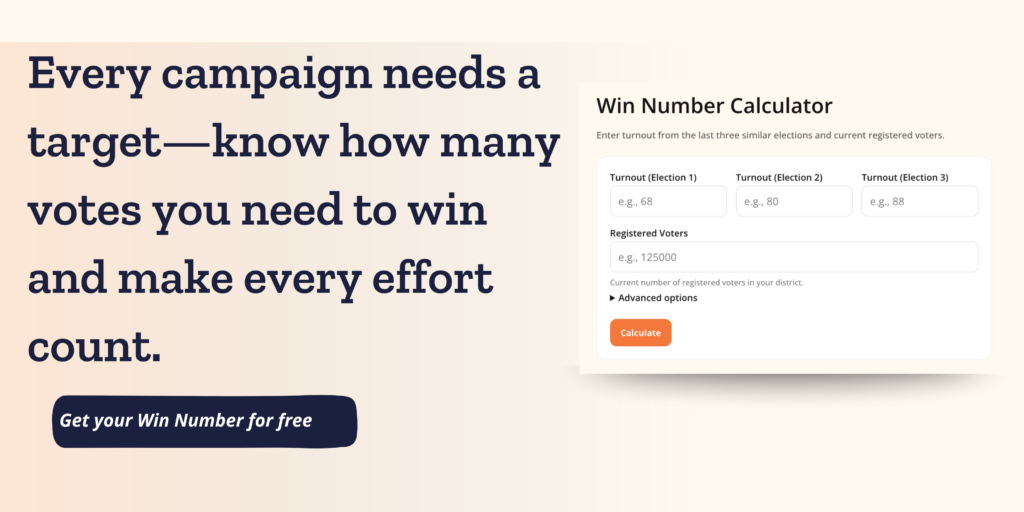
To save time and avoid manual calculations, CallHub offers a free “Win Number Calculator”. Just plug in the numbers, and get your win number in seconds.
Pick your outreach channels based on voter preferences
To run an effective campaign and strategize voter targeting, it’s essential to classify all registered voters into key segments through a Voter Identification (Voter ID) campaign. Typically, these segments comprise the following:
- Strong supporter
- Supporter
- Undecided (Swing Voter)
- Not a supporter
- Strong Opposition
Your initial outreach channel should be a calling campaign to all registered voters. Once voters are segmented, you can tailor your outreach strategies accordingly:
1. Strong supporters
Who are they: Individuals who have consistently voted for your party or have shown strong alignment with your party’s objectives.
Strategy to follow:
- Minimal effort is needed to convince them to vote.
- Engage them in campaigning efforts to help spread your message.
- Encourage them to recruit more supporters from their networks or communities.
- Ideal for volunteering and relational organizing outreach efforts.
2. Supporters
Who are they: Individuals who support your candidate or party but may need additional motivation to vote.
Strategy:
- Focus on getting them to vote on election day.
- Use peer-to-peer outreach and texting campaigns to drive engagement and mobilize turnout.
3. Undecided voters
Who are they: Individuals without a strong opinion toward any party.
Strategy:
- This is the most critical segment for winning elections.
- Allocate a significant portion of campaign resources to win them over.
- Online outreach: Media ads, social media campaigns, email marketing, and your party website.
- Offline outreach: Door-to-door canvassing and community meetings/rallies.
4. Opposition supporters
Who are they: Individuals who currently support other parties.
Strategy: To turn this group of people, your volunteers/candidates will have to address their issues in person to understand why they believe in the opposition and what you could do to get their support. You need a door-to-door campaign, which can be quite expensive.
Managing and appending your list to use voter data
Each step begins with a calling campaign, and as the election campaign moves on, you will interact with these voters more and more. Every interaction, be it-
- A call
- A text message
- Knock on their door
Everything is an opportunity to add more voter data to the list.
You must manage your voter data well, which includes –
- Removing wrong numbers, addresses, or other bad data.
- Segmenting your lists into ever more focused sections, targeting each voter data as per their preference.
- Sort the voter data into supporters, swing voters, and opposition. Also change that affiliation as your campaigning efforts change minds.
| PRO TIP: At any given time, your voter data must be as clean as it can be. And dedicating a resource to this will be worth it in the long run. |
Along with managing the list, you have to append it to your voter data list constantly. What does appending your list mean?
- Adding survey answers from your calling campaigns.
- Adding relevant tags (supporter, swing, etc.) after each interaction.
- Two-way syncing the data from your campaigning software with your CRM constantly.
- Adding more contacts to your lists as you obtain them and start them on your communication cycle.
As technology improves and data analytics become more advanced, voter data is becoming increasingly important in political campaigns. Using data-driven strategies helps campaigns understand voters better, communicate more effectively, and gain support from different communities
In the ever-changing landscape of politics, one thing remains clear: voter data is not just a tool but a fundamental asset that shapes the future of democracy itself.
FAQs on how to use voter data
1. What companies provide voter lists or demographic targeting?
Several companies offer voter lists and tools for demographic targeting. Firms like:
- TargetSmart
- BIGDBM
- Aristotle
- L2
See the details of each in the blog above.
2. Is the center for voter information legitimate?
Yes, the Center for Voter Information is a recognized organization that works to provide voter education and engagement tools. Always verify any organization before sharing or purchasing voter data.
3. How do political campaigns use voter data?
Campaigns use voter data to:
- Identify supporters, undecided voters, and opposition supporters
- Target outreach through calls, texts, emails, and ads
- Personalize messaging to increase voter engagement and turnout
4. Is voter registration public information?
Yes, in most states, voter registration information is considered public. This includes details like name, address, and party affiliation, which campaigns can legally access for outreach purposes.